
buy via net |
To appear in February 2026:
Jedermanns Dämon
Roman
(tentative English title:)
Everyman's Demon
Novel
Vienna: Czernin Verlag, 2026
328 pp.; EUR 25,-
ISBN 978-3-7076-0891-5
Translated publisher's note:
Who doesn't sometimes dream of sin?
Thomas Raab's new novel is inspired by Gothic themes. Right from the beginning we are faced with an unreliable narrator who is struggling to get away from a mysterious plague, but is also in search of his own identity. On the heels of everyman’s demon, the twisted relationships between the individual and society and the demonic in all of us are revealed. A literary puzzle that shifts the boundaries between reality, dream, and delusion, and is hitherto unparalleled in German-language literature.
|

buy via net |
Published in April 2025:
Intelligenz und Phantasie
Zwei Essays zu künstlicher und menschlicher Intelligenz
(tentative English title:)
Intelligence and Imagination
Two Essays on Artificial and Human Intelligence
Berlin: Parodos, 2025
138 pp.; EUR 14,90
ISBN 978-3-96824-036-7
Translated publisher's note:
AI is back. The slogan of artificial intelligence has once more hit the general public and - startled it. Will computers now replace us? Will we forget how to read and write? Are we threatened by endless leisure? Will our children forget how to google? Am I missing out on an investment trend?
The two interrelated essays in this book focus on the question of what intelligence is from a scientific perspective, and whether, as is good practice in science, it can even be coherently defined, behaviorally measured and assessed. The rather monotonous discussion of whether current generative computer programs are intelligent serves as a springboard for more interesting questions about the human organism. The two essays "What does (artificial) intelligence mean?"" and "What does (artistic) imagination mean?"" are based on lectures given by the author in 2023.
Links:
--> Inhaltsverzeichnis als pdf
--> Leseprobe - pdf
|
buy via net |
To appear on 3 July 2023:
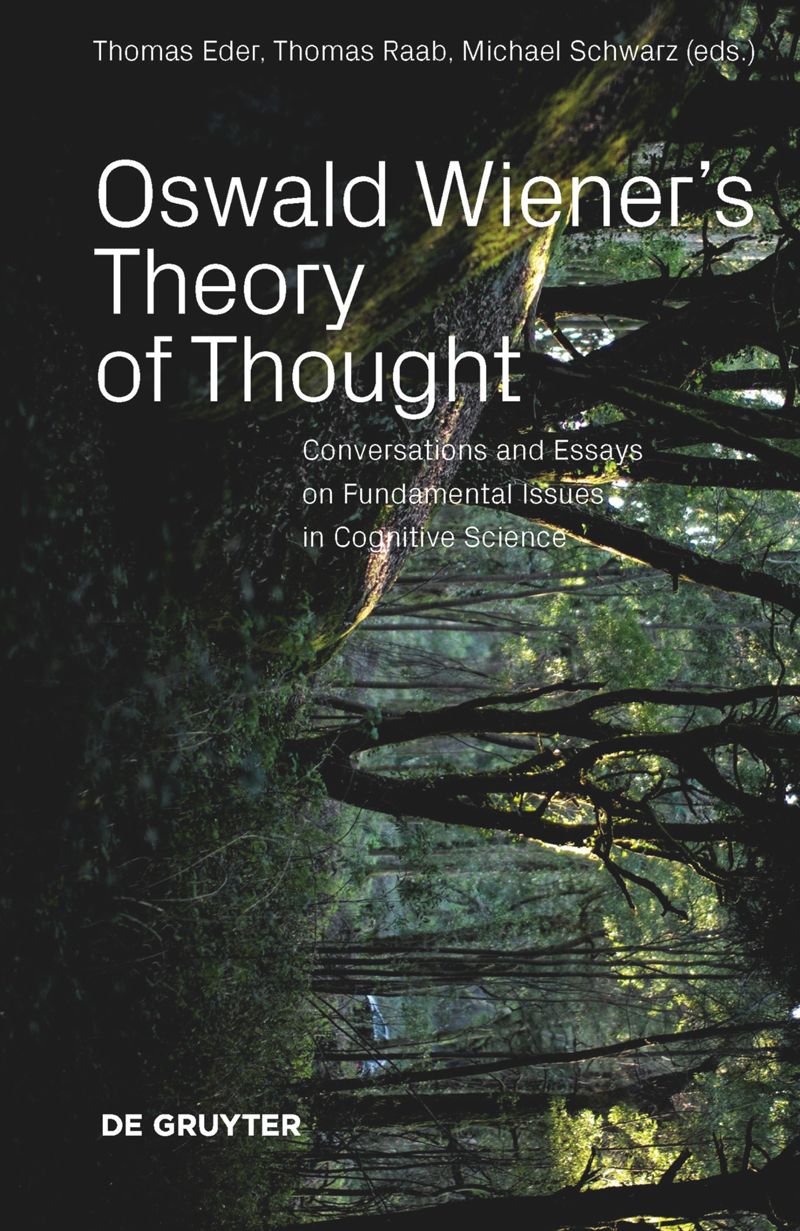
Oswald Wiener's Theory of Thought
Conversations and Essays on Fundamental Issues in Cognitive Science
Edited by Thomas Eder, Thomas Raab, and Michael Schwarz
Berlin, Boston: De Gruyter, 2023
304 pp.; EUR 38,-
ISBN 978-3-11-065961-0
Publisher's note:
What is intelligence? From today's perspective, the intuitive hypothesis that intelligence is a feature of individual organisms that can be operationalized and measured by adaptive performance appears to have failed. Since the ecological turn in both empirical psychology and cognitive science, the crucial role has instead been assigned to the interaction of the individual with conspecifics, groups, and the environment. Hence, the question "What is intelligence?" has become even more urgent, especially in the context of machine "intelligence" and its social implications.
Throughout a life focused on introspection and context, Oswald Wiener (1935-2021) was a pioneer of such an "enactivism" before the word even existed. However, in contrast with the behaviorist orientation of this enactivism, Wiener insisted that thinking, as a process applied to internally generated proxy objects, is an irreducible feature of not only intelligence but also our biological wetware. From his starting point in the arts, he derived such hypotheses from a systematic introspection of general intelligence, which he contrasted with formal computer-based solutions to special problems.
In this book, three conversations with Wiener about the development of his theory and four essays introduce and elaborate on this new approach to the theory of thought, which has previously received too little attention in academic discourse. A pivotal role is played by Wiener's last major essay "Cybernetics and Ghosts."
Advance praise:
"Oswald Wiener was a notable figure in the arts, in science, and in philosophy. What a pleasure to see that his remarkable efforts on the cognitive sciences are being recognized in a new book authored by his close disciples. I highly recommend it."
- Antonio Damasio, Professor of Psychology, Philosophy, and Neurology, University of Southern California
"Oswald Wiener uniquely combines literary and cognitive science approaches to questions of artificial intelligence, cybernetics, and the human mind. In times of increasingly successful simulations of subjectivity, his original thinking is more relevant than ever."
- Thomas Fuchs, Karl-Jaspers-Professor of Philosophy and Psychiatry, Psychiatric University Hispital Heidelberg
Links:
--> Contents as pdf
|

buy via net |
Published on 20 January 2020:
Bobophon
Lehrfabeln
Zeichnungen von Christian Wallner
(tentative English title:)
Bobophone
Contemporary Fables
Drawings by Christian Wallner
Klagenfurt, Graz: Ritter Verlag, 2020
136 pp.; EUR 13,90
ISBN 978-3-85415-600-0
Translated publisher's note:
Who doesn’t know them— the art cockatoo, the discourse bee, the niche tiger, fluffing, struggling, only concerned with themselves? Thomas Raab’s cybernetic tales project biological dynamics on the private and professional life of so-called bobos in universities, art circles, and economy. The continual change between human and animal perspective brings forth analogies between diverse forms of existence, from the moth to the elephant, from algae to fish fingers, from the subordinate to the CEO. Raab’s menagerie of mirroring codes from cell biology, advertising, psychotherapy, and hipster lingo exposes the objective and the mental state of specific social milieus.
The author’s incomparably cool humor, which finds it counterpart in Christian Wallner’s drawings, targets not only the kitschy sentimental and ignorant mentality regarding our fellow humans, but also the meaningless and egomaniacal flutter in sociotopes that Raab himself also belongs to. His is a wittily melancholic and animally funny vista of people in a compound usually kept clean of critical self-reflection.
Links:
--> Review by Sophie Reyer for the 17 June 2020 edition of the Austrian daily Die Presse - in German
--> Review "Raabs Tierleben" (Raab's Animal Life) by Willi Huntemann for literaturkritik.de - in German
--> The BOBOPHONE on the Hotlist-Blog of the German language independent publishers
--> Review by Sebastian Fasthuber in the Viennese village voice – Falter 9/2020, p. 34. - in German
--> Review by Christoph Hartner in Kronen Zeitung, Styrian edition, 2 Feb. 2020, p. 46. - in German
--> Review by Kurt Pohl for trooboox, 5 February 2020 - in German
|
buy via net |
Published in April 2017:
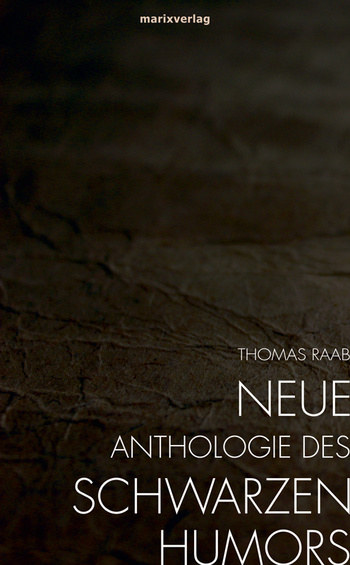
Neue Anthologie des schwarzen Humors
(tentative English title:)
A New Anthology of Black Humour
edited by Thomas Raab
Featuring ten contributions by contenporary artists
selected by Patricia Grzonka
Wiesbaden: Marix Verlag, 2017
404 pp.; EUR 22,-
ISBN 978-3-7374-1042-7
Translated publisher's note:
Never before has man known so much terror and brutality as in our times. How can one protect oneself? By looking away? But hey, that wouldn't be right! Black humor has provided effective self-medication in this context since ancient times. Alas, the dose administered through the classical anthology by André Breton is way too low today, its efficacy being par with a placebo. Fortunately, however, Dr. Raab is here to help! His fine new selection of poetic and subtle everyday delirium from famous and brilliant minds of all times not only guarantees the sparking of ideas but also lets you personally enjoy a world no longer held together by evil but by a silliness far greater. Warning: May contain traces of science!
Links:
--> ToC - pdf
--> Review for German radio WDR on 25 August 2017 by Brigitta Lindemann (including Audio) - in German
--> Nicht ins Schwarze getroffen (Not back in black), a very clear-sighted review essay by Willi Huntemann on 18 August 2017 for literaturkritik.de - in German
--> I also profited from reading Stefan Born's review in Philologie im Netz 82/2017, 55-60 - in German
--> Review in Jungle World (Berlin) 20/2017 by Heike Karen Runge - in German
--> Review in Falter (Vienna) 24/2017 by Sebastian Fasthuber - in German
--> Review in profil (Vienna) 25/2017, p. 85 by Karin Cerny - pdf - in German
--> Review at versalia.de (Berlin), 15. September 2017, by Jürgen Weber - in German
--> A discussion in German for ORF radio "FM4 - im Sumpf" on 26th June 2015 diligently made by Thomas Edlinger can be found here for private use in intentionally gruesome mp3 quality
|
buy via net |
Selbstbeobachtung
Oswald Wieners Denkpsychologie
(tentative English title:)
Introspection: Oswald Wiener's Psychology of Thought
edited by Thomas Eder and Thomas Raab
Berlin: Suhrkamp, 2015
(edition suhrkamp 2669)
498 pp.; EUR 24,-
ISBN 978-3-518-12669-1
Roughly translated publisher's note:
For almost 40 years the Austrian-born writer and cognitive scientist Oswald Wiener has been working on a psychology of thought in order to explain human intelligence. To this end he took up the method of introspection hitherto ideologically neglected due to the strong behavioral bias in academic psychology. To gain intersubjectively comparable observations he developed an objective notion of structure derived from automata theory applicable to describe subjective data. In the past ten years a working group has formed around Wiener whose current state of debate is documented in this book. Following a programmatic introduction and Wiener's two pivotal essays on elementary facts of introspection it charts out a wide field of inquiry documented by the results of several topical (self-) experiments. In the face of today's failing phantasies of omnipotent statistics Introspection certainly deserves a wider public interest.
Links:
--> Contents (in German) - pdf
--> Review by Christoph Lüthy in Der Standard, 25 January 2016 - in German
|
buy via net |
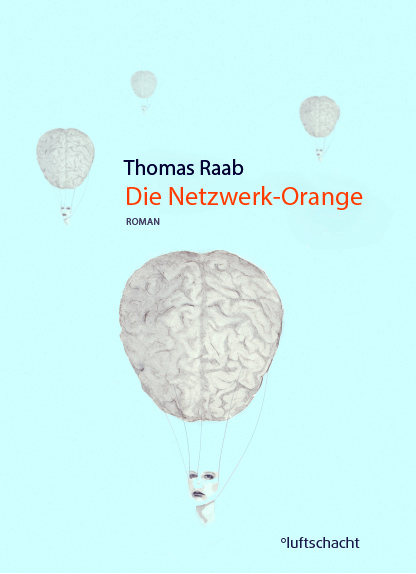
Die Netzwerk-Orange
Novel
(tentative English title:)
The Network Orange
Vienna: Luftschacht, 2015
328 pp.; EUR 24,20
ISBN 978-3-902844-52-4
Translated publisher's note:
We are in the capital city of one of the union states in 2025. Society is functioning. Each person feels individual. Still, small enhancements are always advisable. Franzer, a former psychology professor now serving the interior ministry, tries to convince Miss Buresch, his favorite Ph.D. candidate, to collaborate in the development of a computer therapist - the "cyberist." This advanced machine learning program is already effectively furnishing clients with uplifting fables. In order to persuade Buresch, both of them wander through a social world miraculously stabilized into a few social segment catered to by their respective customized state, or private services. Together these segments form the Network Orange. Still a small group of students dissents. Behind the seemingly perfect fa�ade, Jack, Caren, and Cathy suspect an arcane plot regulating supply and demand.
Is this a utopia or a dystopia? Or, is the Network Orange already real now? Thomas Raab's novel asks what remains of the individual within the "behavior box" we call our world, if we reduce the stabilizing influences of the net. In the dry language of a report, and with ample irony, the author re-enters the literary stage after 10 years of absence trying to recuperate the task of veridical social description from the statistics of the social sciences.
Links:
--> Review "Teil der Maschine und individueller als je zuvor" by Sebastian Fasthuber (Falter 26, 25 June 2015, p. 25) - in German
--> Review by Angelo Algieri, Buchmagazin des Literaturhauses Wien - in German
--> A well-informed review titled "Das neue Uhrwerk und fruchtloses Austicken" by Darius Watolla on literaturkritik.de - in German
--> A discussion in German for ORF radio "FM4 - im Sumpf" on 26th June 2015 diligently made by Thomas Edlinger can be found here for private use as a low-quality mp3
--> Composer Stefan Hetzel on the Network-Orange: "Die kalten Schauer der Alternativlosigkeit" (Cold Shivers of Quasi-Necessity) on der Freitag - in German
--> "Die besseren Zeiten sind auch nichts mehr wert", ein Aufsatz über Satire im utopischen Roman von Clemens Bach in der Jungle World, 22/2016, 8-11. - in German
--> Review "Immer schön brav bleiben!" by Friederike Gösweiner (Die Presse - Spectrum 27.6.2015) - in German
--> Radio review by Tobias Lehmkuhl in "Forum Buch" presented by Carsten Otte (SWR 2, 5 July 2015) - in German
--> Video of a reading performance at EPHEMEROPTERAE VIII of TBA21 in Vienna on 9/11/2015, curated by Daniela Zyman and Boris Ondreička - in German
|

buy via net |
Avantgarde-Routine
Berlin: Parodos Verlag, 2008
(Gedanken 1)
92 pp.; EUR 11,-; ISBN 978-3-938880-21-0
(tentative English title:)
The Avant-garde Routine
Translated publisher's note:
Why are avant-gardes impossible in today's arts? This question would be entirely academic if artists were not themselves still psychologically dependent on the utopian idea of their endeavours' having a pioneering social function. A writer himself, Thomas Raab sets out to trace the causes of the avant-garde in economic conditions, urban demography, and the general orientation of the public. He reconstructs the development of avant-garde movements in the 19th century out of Romantic motives and follows their traces in today's subcultures, the cultural impotence of which is at least contrasted by its economic success. As a small guide for practitioners The Avant-garde Routine demolishes modern illusions about art thereby opening up the perspective of a more powerful illusion: that of a mechanistic self-understanding.
"With a sober humour, the author (...) characterises the artist as a 'willing worker' off the track of well-worn career paths. The originality of the essay lies in its classification of artistic personalities as wheels in the workings of the social machine."
- Anna Opel, Spike - Art Quarterly, 19/2009
Links:
Review of "Avantgarde-Routine" by Paul Pechmann (Falter 50, 2008, p. 55) - German
Radio review of "Avantgarde-Routine" by Frank Kaspar (WDR 3 - Passagen, 18 February 2009) - PDF in German
Radio feature "Kunst, Skandal, Avantgarde" by Ralf Homann (Bayern 2 Radio - Nachtstudio, 7 April 2009) - MP3 PDF - both in German
Short review of "Avantgarde-Routine" by Daniel Völzke (Monopol 3/2009, p. 99) - German
|
buy via net |
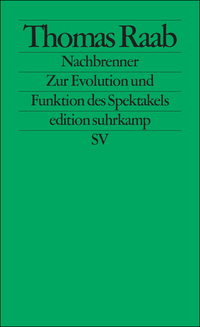
Nachbrenner
Zur Evolution und Funktion des Spektakels
Frankfurt/Main: Suhrkamp Verlag, 2006 (edition suhrkamp 2458)
171 pp.; EUR 9,-; ISBN 978-3-518-12458-1
(tentative English title:)
Afterburner
On the evolution and function of the spectacle
Translated publisher's note:
Almost forty years ago in his book "The Society of the Spectacle", Guy Debord formulated the last fundamental critique of the era of the entertainment industry. It clearly did not change much, though. The repressive power of entertainment is still contrasting increasingly with the cosy shivers of the entertained.
How is this possible? Thomas Raab takes an unusual perspective on the phenomenon: Mass entertainment is not a degenerate form of former high culture, but the necessary consequence of the biological design of man, on the one hand, and the economic development, on the other. His empirical search for an evolutionary 'basis of mass aesthetics' leads him from a fictional protocol of a casting show to numerous observations on himself and small children, as well as on the reactions of his cat, to dogs' howling.
The resulting elements of a new, scientifically based aesthetics help to understand the inconsistent function that the spectacle plays within today's capitalism.
Links:
Review of "Nachbrenner" by Gerd Roellecke (Frankfurter Allgemeine Zeitung, 11.8.2006, p. 37) - German
Conversation about "Nachbrenner" with Stefan Schmitzer (schreibkraft - Das Feuilletonmagazin 15, 2007) - German
Review of "Nachbrenner" by Paul Pechmann (Falter 44, 2006, p. 10) - German
Notes on reviews of "Nachbrenner"
(perlentaucher) - German
Short review by Martin Fritz (The Gap) - German
|

Remaining copies can be ordered through the author
at EUR 10,- plus shipping costs!!
|
Verhalten
Roman
Cologne: Tropen Verlag, 2002
(Trojanische Pferde 7)
192 pp.; EUR 17,80; ISBN 978-3-932170-54-7
(tentative English title:)
Behaviour
Novel
Translated publisher's note:
In his debut "Behaviour", Thomas Raab takes a particular event as a starting point that not only shattered the Austrian public some time ago, but which was also accompanied by the typical reactions of tabloid journalism: The wife of a recognized Viennese psychiatrist attempts suicide by jumping out of a window at their fourth floor apartment after having thrown out their children. Raab declaredly renounces any research into the details, but instead fakes a family drama which he works up into a behavioural model within an urban-life reality.
The anonymity of the protagonists transforms them into wildcard characters with an observable procedure for their behaviour within any Central European city. Social structures, cultural processes, and everyday life are described in a reserved language, which, in its alleged austerity, culminates in a cutting humour. The second part of the book is written from the perspective of the hospitalized mother, who seemingly shows her thoughts and feelings in a dense and enigmatic language.
The subtle composition, the close connection of scientific and poetic language, as well as the empathy of the author with his characters have resulted in an extraordinary debut, illustrating not only the violence and the failure but also the position of love within our society.
Links:
Review of "Verhalten"
(taz, berlin) - German
Review of "Verhalten"
(Tagesspiegel, Berlin) - German
Notes on reviews of "Verhalten"
(perlentaucher) - German
Review of "Verhalten" by Daniela Strigl (Literatur und Kritik) - German
Review of "Verhalten"
by Tina Manske (literaturkritiken.de) - German
Review of "Verhalten"
by Christoph Leitgeb (Der Standard, Vienna) - German
Review of "Verhalten"
by Karin Cerny (Literaturhaus Wien) - German
Text sample
"Verhalten" (Literaturhaus Wien) - German
|
